

How to Choose Water Heater for Your Home
- Della Sparks

- Jul 1
- 6 min read
A water heater usually gets your attention at the worst possible moment - right before school, work, or a house full of guests. If you are wondering how to choose water heater options without wasting money or ending up with another cold shower, the right answer starts with your household, not the sales tag on the unit.
The best water heater is not the biggest one, the cheapest one, or the newest style on the market. It is the one that matches how much hot water your home uses, how quickly you need it, what fuel source is available, and how long you plan to stay in the house. Get those basics right, and you are much more likely to end up with dependable hot water, lower stress, and fewer surprise repairs.
How to Choose Water Heater Based on Your Household
Start with demand. A retired couple in a two-bath home usually needs something very different from a family of five with back-to-back showers, laundry running every day, and a dishwasher cycling at night.
Think about your busiest hour of hot water use, not your average day. If two people shower while the washing machine fills and someone starts the dishwasher, your water heater has to keep up with that peak window. This is where many homeowners get stuck. They replace an old unit with the same size, assuming it worked before, when in reality they may have been living with hot water shortages for years.
For traditional tank water heaters, size is often measured by storage capacity and first-hour rating. Storage capacity tells you how many gallons the tank holds. First-hour rating tells you how much hot water the unit can deliver in an hour when starting with a full tank. That second number matters more in real life.
For tankless models, sizing is about flow rate and temperature rise. In plain English, that means how many fixtures you want to run at once and how much the unit has to heat incoming water. If your home expects multiple showers at the same time, proper tankless sizing is critical. Too small, and someone gets the lukewarm surprise.
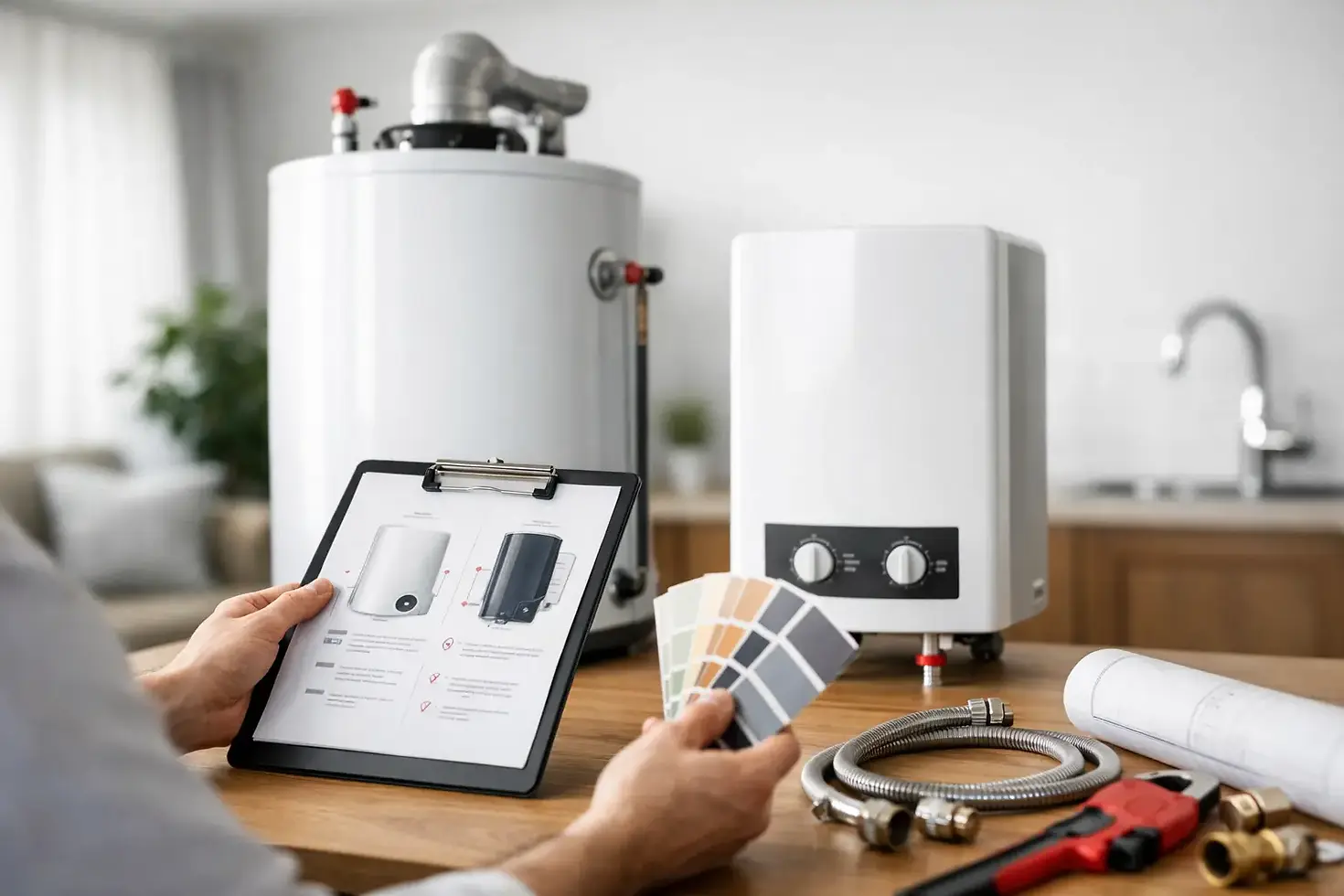
Tank vs. Tankless: Which One Makes Sense?
This is usually the biggest fork in the road. Both options can work well. The right choice depends on your priorities.
Traditional tank water heaters
Tank units are familiar, straightforward, and often less expensive up front. They store hot water and keep it ready. For many households, especially those replacing a failed unit quickly, a tank model is the practical choice because installation is usually simpler and initial cost is easier to manage.
The trade-off is standby heat loss. Because the unit keeps water hot all day, it uses energy even when no one is showering. Tanks also have a fixed supply. Once you use the available hot water, recovery time becomes the issue.
Tankless water heaters
Tankless units heat water as you use it, so there is no large tank sitting full of heated water. They are compact, efficient, and appealing for homeowners who want longer service life and hot water that does not run out under properly sized conditions.
The trade-off is higher installation cost and more sensitivity to correct design. Gas line sizing, venting, electrical needs, and maintenance all matter. In some homes, a tankless upgrade makes perfect sense. In others, it can become more expensive than expected once code upgrades and utility adjustments are part of the job.
If you want the simplest rule of thumb, choose a tank when upfront budget and straightforward replacement matter most. Choose tankless when long-term efficiency, space savings, and performance are priorities, and the home is a good fit for the installation.
Fuel Type Matters More Than Most Homeowners Expect
When people ask how to choose water heater models, they often focus on brand and size first. Fuel type deserves equal attention because it affects operating cost, recovery speed, installation requirements, and even outage performance.
Natural gas is common in many Southern California homes and usually offers faster recovery than standard electric tank models. It can be a strong option for larger families or homes with heavier hot water demand.
Electric water heaters can be effective and reliable, especially where gas is not available or where installation simplicity matters. They may have lower upfront complexity, but operating cost depends heavily on local utility rates.
Heat pump water heaters are another electric option worth considering if efficiency is a top goal. They use less electricity than standard electric resistance models, but they need the right environment and enough installation space. They can also cost more up front, so they are not the right fit for every garage or utility area.
Propane may be relevant in some properties, though it is less common in denser neighborhoods. The best fuel choice is not universal. It depends on what your home already supports and what upgrade costs look like.
Efficiency Is Important, but So Is Real-World Use
High efficiency sounds great, and often it is. But the most efficient unit on paper is not automatically the smartest buy for your home.
A larger, more efficient system may still cost more overall if your household uses modest amounts of hot water. On the other hand, a busy household can justify a higher-efficiency upgrade much more easily because the savings add up faster. That is why honest recommendations should include both installation cost and expected operating cost, not just one or the other.
Also consider maintenance. Some higher-performance systems need more attention to keep working at their best. Tankless units, for example, typically benefit from periodic flushing, especially in areas where mineral buildup is a concern. Skipping maintenance can chip away at the efficiency you paid for in the first place.
Installation Conditions Can Change the Right Answer
This is where online shopping falls short. Two water heaters with similar specs can have very different installation realities.
The location of the unit matters. Is it in a garage, attic, closet, or exterior space? Does the replacement require updated venting, a drain pan, seismic strapping, expansion tank, or code-related safety improvements? In earthquake-prone parts of California, safety details are not optional extras. They are part of doing the job correctly.
Tankless installations may need upgraded gas piping or electrical work. Heat pump units need enough air space to operate efficiently. Even a direct tank replacement can become more involved if the old setup is outdated or unsafe.
This is also a good time to think beyond the heater itself. If long wait times for hot water are a constant annoyance, a recirculation system may be worth discussing. If you are worried about leaks causing damage while you are away, flood prevention technology can be part of a smarter overall plan.
Brand, Warranty, and Serviceability
Homeowners naturally compare brands, but brand alone will not save a poorly sized or poorly installed water heater. A dependable manufacturer matters, but proper selection and workmanship matter just as much.
Look at warranty length, but read it with healthy skepticism. A longer warranty can be valuable, yet it does not always mean lower lifetime cost. Ask what the warranty actually covers, whether labor is included, and how easy it is to get parts and service if something goes wrong.
Serviceability matters too. A unit that is easy to maintain and supported locally is often the better long-term choice than a niche model with impressive marketing claims. When a water heater fails, most homeowners care a lot less about buzzwords and a lot more about getting hot water restored quickly.
A Simple Way to Decide
If you want a practical path forward, narrow the decision with five questions. How many people live in the home? What is your busiest hour of hot water use? What fuel source is already available? Are you focused more on lower upfront cost or lower long-term operating cost? And is this a quick replacement, or are you making a planned upgrade?
Those answers usually point in a clear direction. A smaller household may do just fine with a standard tank. A larger family may need higher first-hour performance or a properly sized tankless system. A homeowner planning to stay put for years may benefit from investing more now for efficiency and reliability later.
If you are unsure, that is normal. Water heaters are one of those home systems that seem simple until you have to replace one. The best guidance is specific to your home, your water use, and your installation conditions. That is exactly why specialist advice tends to save homeowners money and frustration in the long run.
At The Water Heater Wizard, the goal is simple: help homeowners choose a system that fits their home, their budget, and their daily routine so cold showers magically disappear for the right reasons. A good water heater should feel boring in the best possible way - safe, efficient, dependable, and ready whenever your day starts.


Comments